1. COMMITTING
Objective: reducing by 13% SILAB site water withdrawals by 2030 vs 2024
SILAB site water withdrawals (m3)
2. TRACKING AND MASTERING
Sourcing locally
Less than 70 km away from its site, at the foothills of the Massif Central and at the heart of Haute-Corrèze on Millevaches plateau, Longeyroux peat bog gives birth to Vézère river. Amidst essential biodiversity, this land of thousand springs is the source of SILAB water.
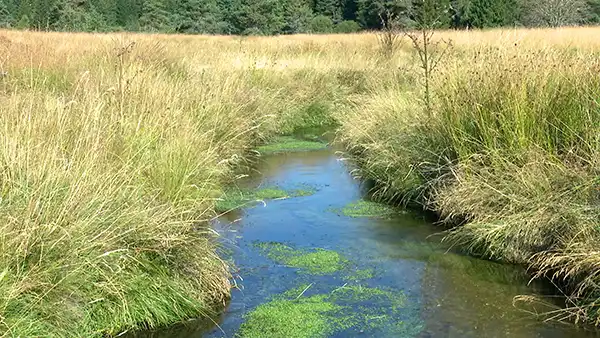 Longeyroux peat bog
Ensuring an irreproachable quality
In order to guarantee product quality and equipment security, water treatment processes upstream of the production units enable SILAB to ensure and use a mastered water quality.
Whether municipal, soften or reverse-osmosis, water must undergo a quality control check framed by strict specifications. To have prompt reactivity, all water circuits were equipped with followed and documented online measures: turbidity, conductivity, temperature.
In addition to the microbiological analyses executed internally, an independent laboratory control confirms the absence of pathogens for the various water quality every month.
3. MEASURING
Creating a dedicated team
A work group of ten people is assigned to master water withdrawals on SILAB site.
Coming from Environment, Project, Maintenance, Production, R&D, and Quality service, they make regular and permanent withdrawal follow-ups, identify ways of improving, implement corrective and preventive action plans, and raise awareness among employees on optimized resource management.
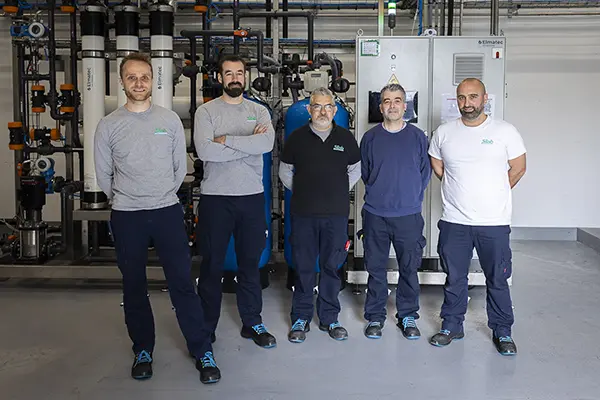 Team dedicated to Water resource
Monitoring water withdrawals
Since 2020, specific follow-ups were conducted thanks to 140 meters distributed across the site. This installation enabled the team to better understand the main withdrawals points as well as quickly detect and treat anomalies.
140
meters
4. AVOIDING AND REDUCING
Raising awareness on eco-gestures
SILAB makes sure to raise awareness among its employees on eco-gestures on an individual scale through several actions:
- integration of an awareness module in new employees’ training program,
- Eco-gesture Guide available to all employees,
- implementation of dedicated signages in the premises,
- regular communication on the actions and the indicators on the intranet,
- awareness actions facilitated, especially for the European Sustainable Energy Week.
For more information, discover the dossier: Raising awareness among our employees on sustainable development challenges
Recovering condensates
SILAB recovers industrial steam condensates directly in the production circuits. This measure prevents these fluids from being rejected in sewers and town water cooling is no longer necessary. The return rate of these condensates increased from 48% in 2020 to 78% in 2022, proof of a continuous optimization of our water management.
Preventing water loss
Anomaly detection and process optimization were successful as water withdrawals decreased by 13% between 2019 and 2025.
Reduction of water withdrawals between 2019 and 2025 (m3)
Anticipating water needs in manufacturing processes
A work group on eco-design was initiated in order to integrate necessary water resources in the product manufacturing processes. This group aims to optimize water use while maintaining product quality.
5. REUSING
Recovering water from Cleaning in place
ReUse project* implementation (investment of 1.2 million euros) is a major operation to save water carried out by SILAB. It aims to recover effluents from Cleaning in place (CIP).
Objective:
-15 to -20%
of overall water withdrawals across the site
Water collected after the separation phase is treated then integrated into the existing water network with the aim to be reused in certain production and cleaning steps.
The commissioning scheduled for 2026 relies on a rigorous analytical follow-up that qualifies the various steps of the process.
*Action financed with Adour-Garonne water Agency’s contest.
6. COMMUNICATING
SILAB was assessed by CDP, a nonprofit international organization which is an environmental performance referential, especially concerning climate change challenges.
In 2025, the company received a B score on the topic of water.