1. COMMITTING
Objective: reducing by 33% greenhouse gas (GHG) emissions by 2030 vs 2024
GHG Emissions (tCO2eq)
In 2020, SILAB defined for the first time its Science Based Targets objectives on scopes 1 and 2.
In 2026, SILAB reviewed its objectives to get aligned with the “1.5°C” trajectory, recognized as essential by the international community in the Paris Agreement.
2030 objectives aim to:
- reduce by 37.43% its greenhouse gas emissions on scopes 1 and 2 compared with 2024,
- reduce by 31.82% its greenhouse gas emissions on scope 3 compared with 2024.
GHG emissions by scope (tCO2eq)
2. MEASURING
To address current environmental challenges, SILAB measures and assesses its impact on the whole value chain thanks to its organizational LCA.
Organizational LCA, a multi-criteria and comprehensive method
Life Cycle Assessment (LCA) is a multi-criteria method based on all the steps of the life cycle of a product or an activity to measure its impacts and implement consistent action plans.
From raw materials purchase to the customer’s delivery, each phase is studied in order to:
- precisely measure environmental impacts,
- identify improvement levers,
- implement consistent and efficient action plans.
Organizational LCA relies on 16 environmental indicators enabling the assessment of impacts.
| Air impacts |
1. Climate change 2. Acidification 3. Photochemical ozone formation 4. Ozone depletion |
| Water impacts |
5. Eutrophication, freshwater 6. Eutrophication, marine 7. Ecotoxicity, freshwater 8. Water use |
| Toxicity impacts |
9. Particulate matter 10. Ionising radiation 11. Human toxicity, cancer 12. Human toxicity, non-cancer |
| Resource impacts |
13. Resource use, minerals and metals 14. Resource use, fossils |
| Soil impacts |
15. Eutrophication, terrestrial 16. Land use |
The Single Score, recommended by the European Commission, is calculated from these 16 indicators and from weighting factors that take their robustness and environmental challenges into account.
An insourced skill
To ensure the rigor and continuity of the approach, two people were trained to lead the LCA internally.
Insourcing this skill enables us to:
- collect inputs and outputs data,
- continuously improve calculation methods,
- fully integrate environmental analysis in strategic decision.
A voluntary and verified approach
Organizational LCA of SILAB is part of a voluntary approach. It demonstrates its desire to go beyond regulatory obligations.
Since 2021, the total amount of greenhouse gas (GHG) emissions covering scopes 1, 2, and 3 has been verified by an independent third party: the data used and the calculation are subject to an annual audit, ensuring their reliability, traceability, and robustness.
Declarations of 2025 were checked by AFNOR Certification according to the GHG protocol and a reasonable assurance.
Discover the recognition: AFNOR Certification verification
This indicator enables the identification of striking facts:
- scope 1: emissions are mainly caused by gas consumption on our site for production and premises heating,
- scope 2: SILAB buys 100% of renewable electricity, its GHG emissions are thus considered non-existent for scope 2 (market-based),
- scope 3: the main categories contributing to scope 3 GHG emissions are purchased goods and services, downstream transportation and capital goods.
3. AVOIDING
Raising awareness and training in good practices
SILAB mobilizes all its employees around concrete actions aiming to contribute to fighting climate change on an individual scale through several actions:
- integration of an awareness module in new employees’ training programs,
- Eco-gesture Guide and Waste Sorting Guide made available to all employees,
- installation of dedicated signages in our premises,
- regular communication of the actions and indicators on the intranet,
- organization of awareness campaigns, especially for the World Climate Day and World Environment Day.
For more information, discover the dossier : Raising awareness among our employees on sustainable development challenges
4. REDUCING
Following the organizational LCA audit, a transition plan was defined with the aim to achieve the targeted objective despite the expected activity growth.
Scope 1
In order to reduce scope 1 GHG emissions, SILAB:
- masters its energy consumptions thanks to its Measuring / Avoiding and Reducing / Reusing strategy. Discover the dedicated dossier here,
- uses biogas: 20% in 2025, targeting 50% in 2030,
- selects a fleet of vehicles less emitting: 1 electric vehicle available on site, hybrid company vehicles.
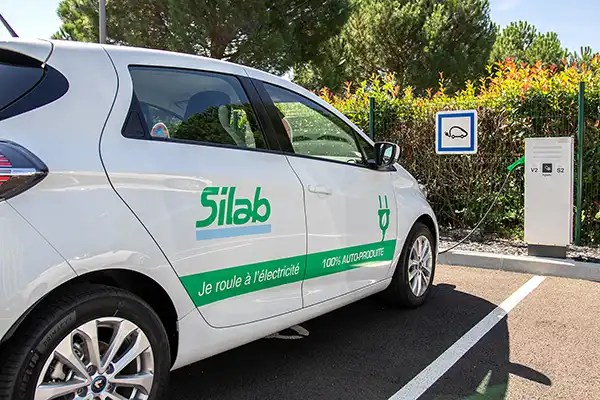 SILAB electric vehicle
Scope 2
SILAB wishes to maintain its GHG emissions. That is why the company:
- masters its energy consumptions thanks to its Measuring / Avoiding and Reducing / Reusing strategy. Discover the dedicated dossier here,
- has been using 100% renewable electricity since 2018,
- has 334 bifacial photovoltaic panels installed on the training center.
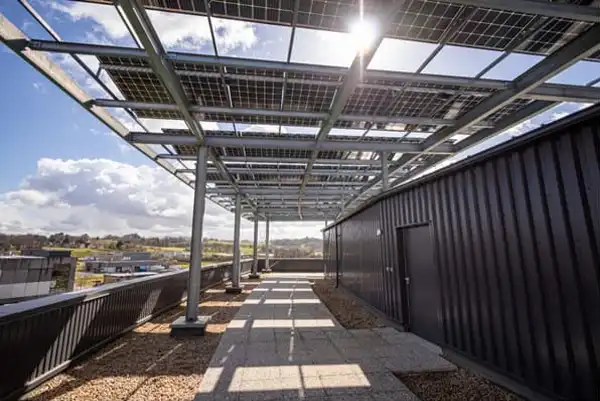 Bifacial photovoltaic panels installed on the training center
Scope 3
Like most companies, SILAB’s challenge is to reduce scope 3 GHG emissions. Thus, the company implemented 3 strong areas of work:
1. Purchased goods and services
By working with our suppliers and our service providers as much on selecting goods and services purchased than measuring their GHG emissions, we want to limit these impacts by 2030.
It also includes the work done by our Agronomic Studies and Research Center (CREA) that aims to develop cultivation itineraries, enabling it to improve supply securing and their environmental impacts.
For more information, discover the dossier: Sourcing Botanical Raw Materials sustainably
2. Capital goods
Since the company is growing and independent, it regularly invests to build its future, which can impact its GHG inventory. For this reason, it wants to include environmental criteria for all new projects.
For example, in 2020, the company ensured the Training Center installation was subject to specifications based on the 14 targets of the French Haute Qualité Environnementale (High Environmental Quality) standards, so that it is more respectful of the environment starting from the early stages of the project to its operation.
3. Downstream transportation
Although the company makes 60% of its 2025 turnover internationally, it has the ambition to reduce air transportation, which is the most emitting means of transportation.
Percentage of air transport from France in volume (%)
In 2025, SILAB made its first good transport to the United States with a sailboat. While still in the test phase, this new means of transportation could be a lever to continue transportation decarbonization.
SILAB also implements various organizational practices daily such as optimizing load rate or grouping orders.
4. Other levers
To achieve its goal, SILAB also plans to maintain actions which have already demonstrated performant results.
- Upstream transportation:
If upstream transportation was part of the most contributing categories of our assessment a few years ago, it represents less than 1% of emissions in 2025.
Percentage of GHG emissions related to upstream transportation (%)
The following actions are now being implemented:
◦ limiting the use of air transportation,
◦ choosing French Botanical Raw Material supply chains.
- Waste:
For many years, SILAB has been targeting zero final waste, which enables the company to master waste impacts. In 2025, recovered waste represented 95% of the volume.
The defined actions include:
◦ favoring waste recycling,
◦ creating energy value with the remaining waste,
◦ limiting final waste.
- Employee commuting:
Located on a single site in Corrèze, our employees often drive to the premises. This is why it is important to provide alternative solutions:
◦ encouraging soft mobility with a sustainable mobility flat rate for employees
◦ making a shuttle available,
◦ making free electrical recharge terminals available,
◦ resorting to remote work.
- Business trips:
In order to limit business trips, the following actions are highly recommended:
◦ considering digital alternatives for some meeting,
◦ favoring train for national business trips,
◦ making a Traveler Guide available since 2025.
5. COMMUNICATING
Assessed by the CDP, a major non-profit international organization in environmental performance, SILAB got a B score in 2025 for its actions related to climate change. The company especially stood out for the quality of its commitment strategy with its suppliers by receiving an A score, thus confirming its position in the “Leader” category.
In 2026, SILAB was awarded for its "carbon score" by EcoVadis, which measures the efficiency of its greenhouse gas management system, enabling it to achieve the rank of leader in terms of decarbonization.