1. COMMITING
Objective: reducing by 58% the frequency rate of occupational accidents
Although the ambition is to achieve zero occupational accident, SILAB has set a realistic objective of reducing their frequency.
Steering committees between human resources and health and security teams have been implemented to continue preventing and reducing occupational accidents.
2. MAPPING
First of all, assessing professional risks is based on the mapping coming from Single Occupational Risk Assessment Document (DUERP). This structuring tool is completed with feedback from employees, which is essential to identify the concrete situations needing to be improved.
Partnerships with specialized organisms strengthen this approach by bringing an external and expert view on working conditions.
Here are the main risks identified:
- fire hazard,
- road risk,
- thermal environments,
- chemical hazard,
- risk related to using machines or manual tools,
- musculoskeletal disorders (MSDs),
- noise exposure,
- psychosocial risks.
3. RAISING AWARENESS AND TRAINING
Raising awareness and training constitute major prevention levers.
Raising awareness
Awareness campaigns are often organized internally:
- 2026: MSDs fire hazard, risk of cutting road risk,
- 2025: road risk, mental health.
For more information, discover the dossier: Raising awareness among our employees on sustainable development challenges
Training
When arriving, all employees benefit from training dedicated to security.
In addition, specific training is provided according to the occupation and the associated risks: chemical hazard, noise exposition, screen work, and mandatory regulatory training.
Training in first aid techniques and how to use fire extinguishers were also implemented.
Awareness campaigns are therefore often provided to employees who are also trained in the risks they may encounter, with particular attention to respect to safety rules specific to each service.
4. INVOLVING
Security culture becomes concrete with a strong presence of workplace first-aiders.
74
workplace first-aider employees in 2025
A dedicated section on the intranet enables them to get access to practical resources to efficiently intervene. In complement, a specific guide is also available.
5. PREVENTING
SILAB takes a hierarchized approach first by promoting the prevention of risk identified at the source and collective actions before resorting to individual protection.
Fire hazard
SILAB has implemented a complete system including sensitive detectors, a water sprinkler system, fire doors and smoke vents completed with strict regulations on flammable material storage and dedicated smoking areas on the site.
To guarantee prompt response from everyone, we organize regular and various fire drills. At the same time, continuous training of our teams ensures that each employee knows how to act immediately and efficiently to protect people and goods.
Road risk
To prevent road risk, SILAB created a business travel policy notably based on a rigorous organization of the missions, including itinerary choices made according to weather conditions, respect of break times, and regular and systematic maintenance of our fleet of vehicles. Employees are regularly informed on the specific dangers and eco-driving topics.
Thermal environments
To guarantee our teams’ well-being against thermal environments, SILAB favors a global approach combining improvement of the work environment, smart task organization, and adapted equipment.
Collective protection is strengthened with the implementation of watering places, cold rooms, and rest rooms with air conditioning, while insulated clothes ensures efficient individual protection.
Chemical hazard
SILAB adopts a proactive approach to master chemical hazard by promoting the replacement of substances at risk with safer alternatives as soon as the conception of processes. This strategy relies on operational rigor associating storage management, exposition study, and the use of collective and individual protection equipment.
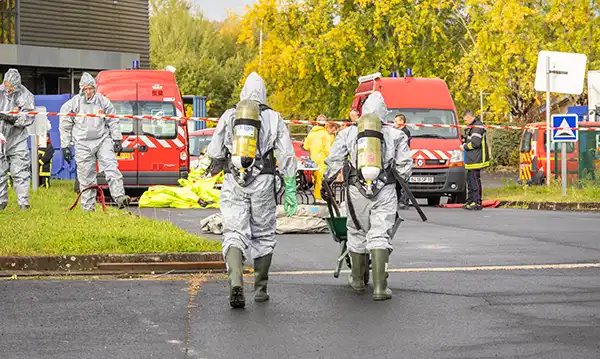 Simulation of a chemical leakage supervised by firefighters - 2025
Risk related to using machines or manual tools
To master risks related to using machines or manual tools, SILAB combines technical rigor and equipment adaptation. Collective protection relies on insulating areas at risk, strict preventive maintenance, and restricted access to authorized people only. This approach is strengthened with continuous training, instruction display, specific manual tools availability, and appropriate individual protection equipment systematically worn.
Musculoskeletal disorders (MSDs)
A detailed study on industrial workstations demonstrated low repetitive gestures according to the criteria defined by the French national research and safety institute (INRS).
However, SILAB makes adapted equipment available in order to prevent risks and preserve employees’ health:
- Exoskeletons: active assistance devices, easy to install and no movement restrictions, preventing lumbar pain and improving working conditions,
- Adapted office equipment: exercise balls alternating with office chairs and mice with ergonomic designs are made available,
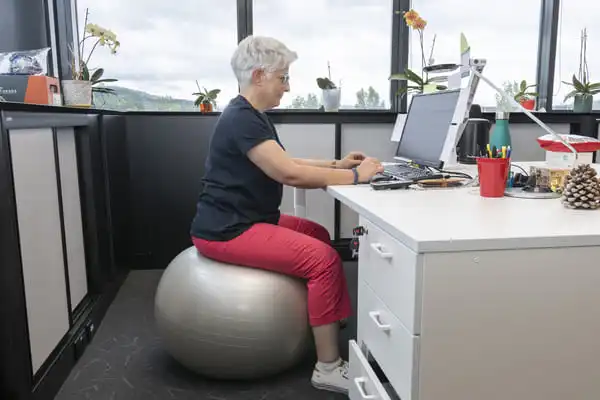 Relieving lumbar pain: exercise ball
- Laboratory furniture: chairs with ergonomic designs to support employees’ movements were selected.
In addition, in 2024, kinesiologists presented practical exercises, postural advice, and educational materials to the team aiming to prevent MSDs, reduce injury risks, and limit pain occurring.
Noise exposure
Acoustic measures were conducted by an external organism: no employee is exposed to noise level requiring specific protection measures.
Concerned about its employees’ acoustic health and comfort, SILAB takes proactive measures to reduce noise level at source, thanks to the purchase of less noisy machines, rigorous preventive maintenance, and the integration of acoustic criteria starting from equipment conception.
This approach is completed with collective protection such as insulation and confinement of sounds sources along with an optimized work organization, including access restriction to noisy areas, and intervention planning.
Finally, for exposed employees, SILAB guarantees the supply and mandatory wearing of adapted individual protection equipment (modeled caps or headsets) combined with medical checkups.
Psychosocial risks
SILAB acts concretely on reducing stress and overload by promoting work-life balance, in particular by implementing the Right to Disconnect Charter, resorting to remote work, and clarifying work objectives.
Finally, our managers’ continuous training and regular Quality of Life and Working Conditions surveys enable SILAB to identify needs, adjust its practices, and maintain a healthy, kind, and high-performance work environment.
78%
of employees considering having a satisfying work-life balance in 2024
6. CORRECTING
Each accident or almost accident, even minor, is subject to a specific analysis. This approach enables SILAB to precisely identify the causes and implement adapted corrective actions.
The aim is to avoid any recurrence by continuously improving working conditions and prevention systems.