1. COMMITING
Objective: training at least 95% of employees every year
Percentage of employees trained at least once a year (%)
2. TRAINING EMPLOYEES WHEN ARRIVING
Organizing a complete integration program
When arriving, each employee follows a training program designed to make them discover the company: environment, quality, security, confidentiality, etc.
During the first few weeks, an individual training program is provided to facilitate meeting colleagues and identifying their functions and those of their interlocutors.
Immersion in various services can also be organized to provide a concrete vision of the company’s occupations.
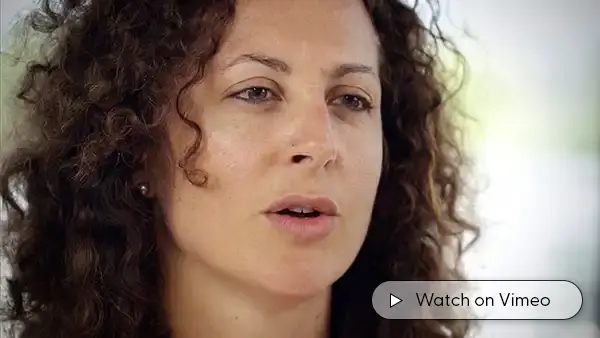 Discover SILAB integration course… from Anne Domi’s point of view
Being supported by a tutor
Support for new employees, apprentices and trainees constitutes a strong aspect of their training. Tutors are trained for this mission and use their expertise to transmit knowledge and skills. Thanks to this structured framework, new employees benefit from quality support which encourages their sustainable integration in the company.
Getting trained for the position
A training booklet handed during the integration phase details the various steps of the position training program. Each employee, supported by its dedicated tutor, benefits from specific training during the first few months, enabling them to progressively acquire knowledge and skills required for their accomplishment.
3. INVESTING IN TRAINING
Training whether internal or external represents an investment in human resources but also in educational tools, which are both essential for the company’s sustainable performance.
En 2025, one SILAB employee benefits on average from 17 hours of training per year.
100%
of employees were trained at least once a year in 2025
Relying on a community of internal trainers
In addition to the training dispensed by external organisms, 45 employees expert in their field facilitated training in 2025 to support the company’s evolution.
That same year, 110 internal training modules were provided in all specialties, either face-to-face or digitally.
 Training by an internal expert
Using tools to expand the training offer
Tools are available to complete the face-to-face training offer: about twenty training modules were adapted in digital or blended learning and LMS (Learning management system) and LCMS (Learning content management system) technologies provide new training modes offering interactive and expanded experience.
Having high-performance material resources available
Employees benefit from an internal training center having high-performance educational tools and many spaces dedicated to training: a 200-seat lecture hall, specialized laboratories, a IT rooms, adjustable training rooms and spaces equipped for remote training (self-training, webinars, etc.).
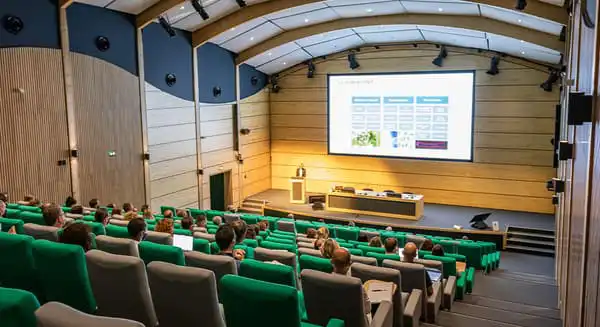 SILAB’s lecture hall
4. SUPPORTING CAREER PLANS
Conducting regular meetings
Annual and multi-year meetings hold a central place in career plans management. Personalized meetings dedicated to training are organized every year between the employees and their manager. Career plan meetings take place every four years and at key stages of employees’ careers with their manager or the HR service. These privileged discussions enable each party to identify needs in skills development, to align individual aspirations with the company’s objective and support continuous growth in expertise.
Ensuring continuity
In its Business Continuity Plan (BCP), SILAB regularly maps all its employees’ skills. Action plans are conducted and monitored to guarantee the continuity of key skills of the company.
Providing career prospects
In this dynamic, supporting employees is part of a global and structured approach. The company anticipates occupations and skills evolutions thanks to a thanks to its Strategic Workforce Planning policy (adapted to the French GEPP legal framework). It encourages internal mobility and mobilizes concrete certification levers such as the PRO-A scheme, enabling permanent contract employees to access professional certification with an apprenticeship or Validation of acquired experience (VAE) which transforms experience into a recognized degree. This kind of approach guarantees that the resources and the company’s future challenges coincide while providing employees with clear and motivating career prospects.
Implementing standardized job descriptions and precise associated skills contributes to reinforcing career plans comprehensibility. They promote career development and internal bridges and encourage constructing career trajectories in line with individual ambitions and the organization needs.