1. COMMITTING
Objective: reducing energy consumption by 5% in intensity by 2030 vs 2024
Energy consumption per euro of turnover (MWh/€M)
2. MEASURING
Relying on a dedicated and trained team
Energy monitoring relies on a multidisciplinary team of three employees from Environment, Project, and Maintenance services.
Two of them followed an “energy advisor” specific training program providing them with a precious technical expertise to identify high impact action levers.
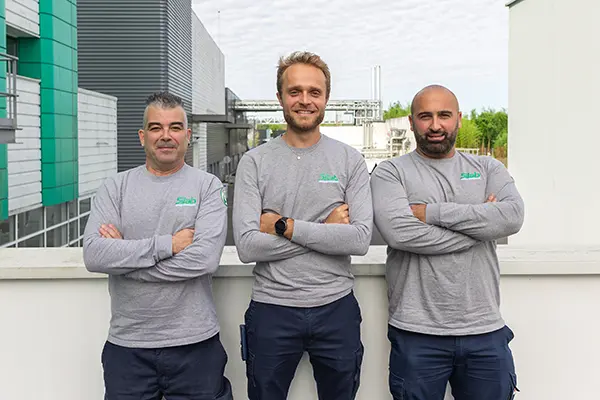 Team dedicated to Energy
Mapping consumptions
- Energy audit: carried out regulatively every four years, it enables SILAB to create a precise map of its consumptions and identify new ways of improving. The last one was conducted in 2024.
- Measuring plan: SILAB has implemented an energy measuring plan in order to identify the location of various meters, enabling usage mapping and unusual consumptions tracking.
◦ In 2026, a measuring system was studied, that being a software able to centralize and analyze energy consumption data.
◦ In 2025, a counting system was implemented to connect all meters to the centralized technical management system thereby enabling monitoring of energy consumption daily across the entire site.
◦ At the end of 2024, 20 electric meters had completed the 37 already existing on more recent buildings.
+50
meters
3. AVOIDING AND REDUCING
Raising awareness on eco-gestures
SILAB strives to raise awareness among its employees on eco-gestures on an individual scale through several actions:
- integration of an awareness module in new employees’ training,
- Eco-gesture Guide available to all employees,
- installation of dedicated signages in the premises,
- regular communication of the actions and the indicators on the intranet,
- awareness actions facilitated, especially for the European Sustainable Energy Week.
For more information, discover the dossier: Raising awareness among our employees on sustainable development challenges
Preventing energy loss
Reducing energy consumption is daily work. Here are a few action examples:
- Immediate repairing of leaks: using an ultrasound leak detector for a prompt response,
- Optimization of compressed air network pressure: replacing the compressed air distributor and reducing the network pressure prevented a 30,000 m3 of compressed air loss, that being 3% of the electricity consumption of the site in 2022,
- Modernizing lighting: after having equipped 70% of its installation with LEDs in 2021, SILAB achieved 90% in 2024,
- White paint on the roofs: roofs of two buildings were painted white at the end of 2025 enabling a 2°C to 3°C reduction in 2025 vs 2024.
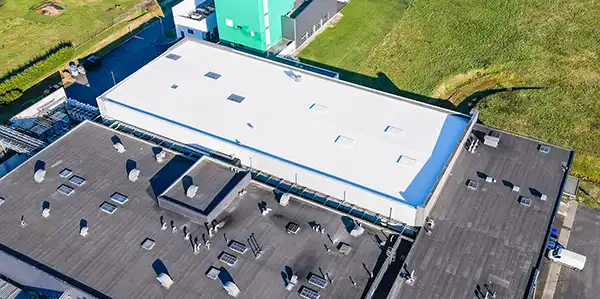 White paint on the roof of a building
4. REUSING
Recovering energy from refrigeration units
Between 2020 and 2022, an energy saving plan requiring an investment of 3 million euros was implemented, including an ambitious project to recover energy carried out in 2021, in order to improve the energy performance of its industrial facilities.
The aim was to replace iced water production units with a single more performant unit equipped with an innovative heat recovery system.
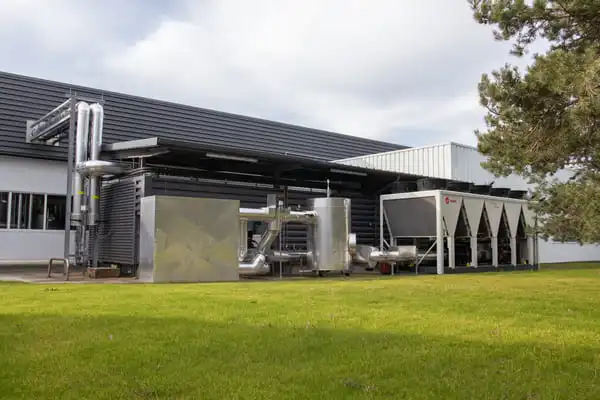 Refrigeration unit with the heat recovery system
Thanks to this specific system:
- calories generated by the refrigeration unit are recovered,
- hot sanitary and softened wastewater of the three production units are preheated.
Savings made with the implementation of these installations were quantified in 2022 vs 2021:
5. CONSUMING BETTER
SILAB pursues its energy transition by integrating more renewable sources into its energy mix.
In 2025:
Since 2024, SILAB has been committed to a progressive transition toward biogas, an energy coming from creating value from organic materials, with the objective to achieve 50% by 2030.
Since 2020, SILAB internal training center has been a good example of energy autonomy since it is equipped with 334 bifacial photovoltaic panels that have covered 75% of the building energy consumption in 2025.
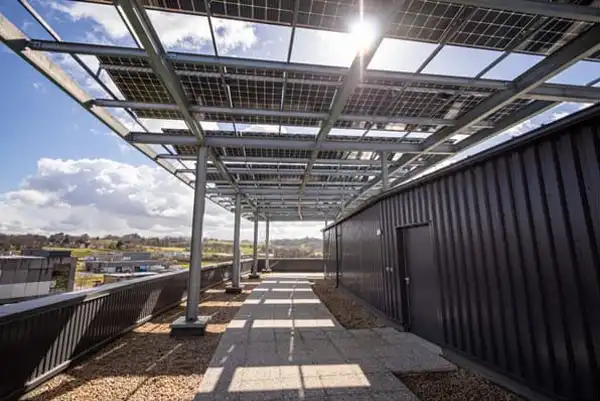 Bifacial photovoltaic panels installed on the training center
Since 2018, SILAB has been subscribing to Renewable Energies guarantees of origin for its electricity which correspond to an equivalent production coming from renewable sources.